
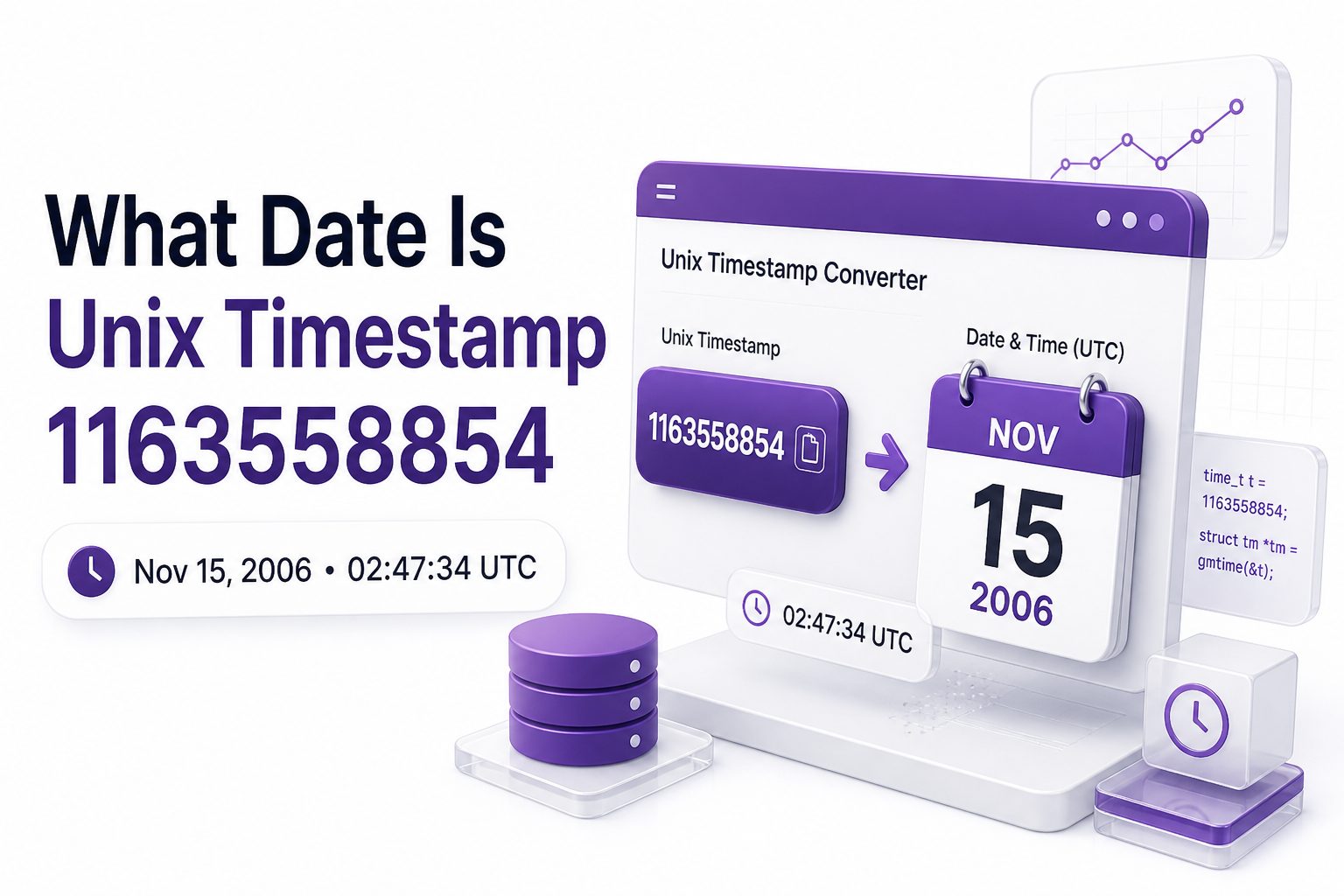
Unix timestamps are small numbers with a lot of meaning behind them. If you have ever copied a timestamp from a database, log file, API response, analytics report, or old software record, you may have wondered how to translate it into a normal calendar date. The search for what date is unix timestamp 1163558854 has a clear answer: it represents Wednesday, November 15, 2006, at 02:47:34 UTC.
That single number is based on the number of seconds that passed after January 1, 1970, at 00:00:00 UTC. Developers, system administrators, data analysts, and technical marketers still use Unix time because it is compact, consistent, and easy for computers to compare. The tricky part is that humans do not read time as one long second count. This article explains the exact conversion, why time zones can change the displayed date, and how to check similar timestamps accurately.
Unix Timestamp 1163558854 Date Result
Unix timestamp 1163558854 converts to Wednesday, November 15, 2006, at 02:47:34 UTC. UTC is the standard reference time used for Unix timestamps, which means this is the safest baseline answer before applying any local time zone.
If your system displays the same timestamp in a local time zone, the visible date and hour may change. For example, users in western time zones may see the previous calendar day, while users east of UTC may see a later hour on November 15.
How Unix Time Counts Seconds
Unix time counts the number of seconds since the Unix epoch, which began on January 1, 1970, at 00:00:00 UTC. The timestamp 1163558854 means exactly 1,163,558,854 seconds passed after that starting point.
This format avoids month names, weekday names, and regional date styles. A timestamp can move between systems without confusion, as long as every system treats the value as seconds in UTC before formatting it for readers.
Quick Facts About Timestamp 1163558854
- UTC date: Wednesday, November 15, 2006
- UTC time: 02:47:34
- ISO 8601 format: 2006-11-15T02:47:34Z
- Unix format: 1163558854
- Time standard: Coordinated Universal Time
- Epoch starting point: January 1, 1970, 00:00:00 UTC
Why UTC Is the Standard Reference
UTC keeps timestamp conversion stable across countries, servers, and software platforms. When someone asks what date is unix timestamp 1163558854, the most reliable answer is the UTC result, because it does not depend on where the person or server is located.
Without UTC, timestamps would become difficult to compare. A log generated in London, a database in New York, and an API in Tokyo could all show different local times for the same event, creating confusion during audits or debugging.
Local Time Zone Conversions
The same timestamp can appear differently depending on time zone settings. In Berlin, timestamp 1163558854 displays as November 15, 2006, at 03:47:34 CET because Berlin was one hour ahead of UTC at that date.
In New York, the timestamp displays as November 14, 2006, at 21:47:34 EST. This is why timestamp conversion tools often ask for a location or time zone before showing a user-facing date.
Common Display Formats
Format | Result
UTC readable date | November 15, 2006, 02:47:34 UTC
ISO 8601 | 2006-11-15T02:47:34Z
US date format | 11/15/2006 02:47:34 UTC
European date format | 15/11/2006 02:47:34 UTC
Berlin local time | 15/11/2006 03:47:34 CET
New York local time | 11/14/2006 21:47:34 EST
Why Timestamp Conversions Can Look Different
Timestamp conversions can look different because formatting and time zone settings are separate from the timestamp itself. The number 1163558854 does not store a city, daylight saving rule, or preferred date style.
A database may store the raw Unix value, while an application converts it for the logged-in user. That is useful for usability, but it can cause confusion when two people compare the same event from different regions.
The Role of Daylight Saving Time
Daylight saving time can affect the local display of a timestamp, especially for older records. On November 15, 2006, many regions that observe daylight saving had already returned to standard time.
For this timestamp, Berlin used CET, which is UTC+1. New York used EST, which is UTC-5. Those offsets produce different local times even though the underlying Unix timestamp remains unchanged.
Practical Checks Before Using a Converted Date
- Confirm whether the timestamp is in seconds or milliseconds.
- Convert the value in UTC first.
- Apply the correct local time zone only after the UTC conversion.
- Check historical daylight saving rules for old timestamps.
- Use ISO 8601 format when sharing technical date values.
- Document whether a report uses UTC or local time.
Seconds Versus Milliseconds
Unix timestamps are commonly stored in seconds, but JavaScript and some APIs often use milliseconds. The value 1163558854 is a seconds-based timestamp, which gives a normal date in 2006.
If you accidentally treat it as milliseconds, the result will point to a date in January 1970. That mistake is common when moving between backend systems, browser code, spreadsheets, and third-party APIs.
How to Spot the Difference
A seconds-based timestamp around 2006 has 10 digits, like 1163558854. A millisecond timestamp for the same period usually has 13 digits, because it includes three extra digits for milliseconds.
When a date conversion result looks wildly wrong, digit count is the first thing to check. A 10-digit value usually needs seconds-based conversion, while a 13-digit value usually needs millisecond-based conversion.
Example Timestamp Comparisons
Timestamp | Type | Approximate Meaning
1163558854 | Seconds | November 15, 2006, 02:47:34 UTC
1163558854000 | Milliseconds | November 15, 2006, 02:47:34 UTC
1163558 | Seconds | January 1970
1163558 | Milliseconds | January 1, 1970, shortly after epoch
How Developers Convert Timestamp 1163558854
Developers usually convert Unix timestamps using built-in date functions. In many programming languages, the process is simple because the standard libraries already know how to calculate calendar dates from epoch seconds.
For example, a backend application might store 1163558854 in a database column, then format it as 2006-11-15 02:47:34 UTC for logs, reports, or user interfaces. The stored value stays numeric, while the display becomes readable.
Python Conversion Example
In Python, the timestamp can be converted with the datetime module. A UTC-safe conversion returns November 15, 2006, at 02:47:34, matching the direct answer for what date is unix timestamp 1163558854.
Python developers should prefer timezone-aware date objects when working with stored timestamps. That prevents accidental use of the server’s local time zone, which can quietly change displayed results during deployment or migration.
JavaScript Conversion Example
JavaScript Date objects expect milliseconds, so developers must multiply a seconds-based Unix timestamp by 1000. For timestamp 1163558854, the correct JavaScript input is 1163558854000.
This difference is one of the most frequent timestamp bugs in frontend code. If a date appears near 1970, the code probably passed seconds into a function that expected milliseconds.
Useful Timestamp Conversion Tips
1. Keep raw timestamps in UTC for storage.
2. Convert to local time only for display.
3. Label reports clearly with UTC, CET, EST, or another zone.
4. Use ISO 8601 for APIs and technical documentation.
5. Test conversions around daylight saving changes.
6. Avoid relying on server default time zone settings.
Why Unix Timestamps Are Still Used
Unix timestamps remain popular because they are efficient and easy to compare. Sorting records by numeric timestamp is faster and less ambiguous than sorting human-readable date strings with different formats.
They also work well in logs, databases, APIs, analytics events, and distributed systems. A single timestamp can represent the same moment everywhere, even if each user eventually sees it in a local date format.
Where You Might See Timestamp 1163558854
You might find a value like 1163558854 in legacy database exports, archived server logs, old CMS records, payment events, or analytics snapshots. Many systems created in the 2000s stored dates as Unix seconds.
If you are cleaning old data, converting timestamps helps restore context. Knowing that the value points to November 15, 2006, can help connect the record to a release, transaction, content update, or system event.
Common Places Unix Timestamps Appear
- Server access logs
- Database created_at and updated_at fields
- API responses
- Event tracking systems
- CMS publishing records
- Backup metadata
- Authentication sessions
- Payment processor webhooks
- File system records
- Analytics exports
Best Format for Sharing the Converted Date
The best technical format for this timestamp is 2006-11-15T02:47:34Z. The Z indicates UTC, which removes uncertainty and makes the value suitable for APIs, logs, tickets, and documentation.
For non-technical readers, Wednesday, November 15, 2006, at 02:47:34 UTC is easier to read. If your audience is local, add the local time zone next to it, but keep UTC as the source of truth.
Using the Date in Reports
Reports should state whether timestamps are shown in UTC or local time. A date like November 15, 2006, may become November 14, 2006, for users in some American time zones.
This matters when reporting revenue, traffic, signups, incidents, or publishing history. If the report groups events by local calendar day, the same timestamp may fall into a different daily bucket than it would in UTC.
Recommended Reporting Labels
Label Type | Example | Best Use
UTC label | 2006-11-15 02:47:34 UTC | Logs, APIs, audits
ISO label | 2006-11-15T02:47:34Z | Technical exports
Readable label | November 15, 2006, 02:47:34 UTC | Blog posts and guides
Local label | November 14, 2006, 21:47:34 EST | User-facing dashboards
Mistakes to Avoid When Converting Unix Time
The most common mistake is ignoring whether the value is measured in seconds or milliseconds. Timestamp 1163558854 is seconds-based, and converting it as milliseconds will produce the wrong result.
Another mistake is forgetting time zones. A UTC conversion and a local conversion can both be technically correct, but they answer different questions. Always decide whether you need the universal moment or the reader’s local display.
Historical Dates Need Care
Older timestamps deserve extra attention because time zone rules may have changed over the years. Governments occasionally adjust daylight saving schedules, offsets, and regional rules, which can affect historical local conversions.
For timestamp 1163558854, UTC gives a stable answer that will not change. Local representations should be generated with reliable time zone data, especially when legal, financial, or audit records are involved.
Simple Conversion Checklist
- Start with the raw timestamp value.
- Confirm it has 10 digits and is measured in seconds.
- Convert it to UTC first.
- Record the UTC result as the primary reference.
- Convert to local time only when needed.
- Include the time zone abbreviation or offset in the final display.
- Use consistent formatting across reports and tools.
Using Timestamp Conversions for SEO and Content Work
Searches like what date is unix timestamp 1163558854 usually come from people who need a direct answer quickly. A good timestamp article should give the exact date first, then explain the surrounding details without burying the result.
For content teams, timestamp guides can support technical audiences searching for date conversion help. Related resources such as [Internal Link: Unix Timestamp Converter] or [Internal Link: Epoch Time Explained] can help readers move from one specific timestamp to broader time conversion topics.
Matching Search Intent
The intent behind this query is informational and practical. The reader wants to know the calendar date, but they may also need help interpreting UTC, local time, ISO format, or seconds versus milliseconds.
A useful answer should not overcomplicate the first result. State the converted date clearly, then add enough context for readers who need to apply the same process to logs, scripts, spreadsheets, or application data.
Content Elements That Help Readers
- A direct date conversion near the top
- UTC and local time examples
- ISO 8601 formatting
- Notes about seconds and milliseconds
- Simple tables for comparison
- Practical developer examples
- Clear warnings about time zone differences
- Internal links to related timestamp resources
When Local Date Matters More Than UTC
UTC is best for technical accuracy, but local date can matter more in user-facing contexts. A customer receipt, content publish time, or regional analytics dashboard may need to show the date in the user’s own time zone.
For example, timestamp 1163558854 appears as November 14, 2006, in New York. If a business report is grouped by Eastern Time, that event belongs to November 14, not November 15.
Choosing the Right Time Zone
The right time zone depends on the purpose of the data. System logs should usually stay in UTC, while customer-facing displays should use the user’s location or account preference.
For teams working across regions, it helps to show both UTC and local time. This keeps engineers, analysts, support staff, and customers aligned when discussing the same event.
UTC Versus Local Time Comparison
Use Case | Recommended Time
Server logs | UTC
API records | UTC
Customer dashboard | User’s local time
Legal audit trail | UTC plus local context
Marketing analytics | Account reporting time zone
Support tickets | UTC plus customer time zone
Database storage | UTC timestamp
How to Verify the Date Manually
You can verify the timestamp manually by starting from January 1, 1970, and adding 1,163,558,854 seconds. In practice, most people use reliable date libraries or conversion tools because manual calculation is slow and error-prone.
Still, the manual logic is useful. The timestamp lands 318 days into 2006, plus 2 hours, 47 minutes, and 34 seconds after midnight UTC on November 15.
Why Manual Math Is Rare
Calendar math involves leap years, month lengths, and time zone offsets. Once local time enters the picture, daylight saving rules add another layer of complexity.
That is why developers rely on date libraries instead of hand-built conversion logic. Libraries reduce mistakes and make the conversion repeatable across environments, tests, and reporting tools.
Reliable Verification Methods
- Use a programming language date library.
- Check with a reputable Unix timestamp converter.
- Convert first to UTC, then to local time.
- Compare ISO 8601 output against readable output.
- Confirm the timestamp unit before testing.
- Avoid spreadsheet auto-formatting until the value is converted correctly.
Conclusion
Unix timestamps can look cryptic at first, but they are simply second counts from a fixed UTC starting point. The value 1163558854 represents a precise moment, and the best baseline conversion is Wednesday, November 15, 2006, at 02:47:34 UTC. Once local time zones are applied, the displayed time can shift, and in some locations the calendar date can move to November 14.
The most important habits are straightforward: confirm whether the timestamp uses seconds or milliseconds, convert in UTC first, and label any local display clearly. Those steps prevent confusion in logs, reports, databases, and user-facing interfaces. For anyone asking what date is unix timestamp 1163558854, the direct answer is clear, but the surrounding context helps you use that answer correctly in real technical work.
FAQ
What date is timestamp 1163558854?
Timestamp 1163558854 is Wednesday, November 15, 2006, at 02:47:34 UTC. This is the standard Unix time conversion before applying any local time zone or regional formatting.
Is 1163558854 in seconds or milliseconds?
The value 1163558854 is a seconds-based Unix timestamp. If it were milliseconds, it would usually have 13 digits, such as 1163558854000 for the same UTC moment.
What is the ISO format for 1163558854?
The ISO 8601 format is 2006-11-15T02:47:34Z. The Z means the date and time are expressed in UTC, which is the standard reference for Unix timestamps.
Why does the date change by time zone?
The timestamp represents one fixed moment, but local time zones shift the displayed clock time. In New York, this timestamp appears as November 14, 2006, at 21:47:34 EST.
Can I store Unix timestamps in databases?
Yes, Unix timestamps are commonly stored in databases because they are compact and easy to sort. For clarity, store them as UTC values and convert them only when displaying dates to users.
0 Comments